What should go on the lower shelves of a bookcase?
The lower shelves of a bookcase work best with items that are sturdy, easy to reach and not too precious. Heavy books, woven baskets, boxed sets, larger ornaments and a few practical display pieces usually suit this area better than delicate objects. In a compact room, the lowest shelves also help the furniture feel grounded, so the aim is useful storage with a clear visual reason for being there.
This matters even more when space is tight. A narrow bookcase in a living room, bedroom or study has to earn its place, and the bottom of it is often the part people glance at first when walking past. If it is crowded with awkward objects, the whole unit can look busy. If it holds a neat run of books, a basket or a calm display, it makes the room feel more settled.
Start with weight and reach
The first question is simple: what is safest and easiest to lift from a low shelf? Large hardback books are a natural choice because they carry visual weight and sit neatly in rows or small stacks. They are also less of a stretch than items kept higher up. Paperback books can work well too, though a long run of mixed sizes may look restless unless you group them by height or colour.
Keeping heavier items low can also improve the feel of the furniture. A bookcase with a solid base looks more stable than one with bulky objects perched near the top. That does not mean every lower shelf must be packed with the heaviest things you own. It means the bottom should not be reserved for lightweight trinkets while large, awkward pieces sit above eye level.
Think about how the shelf is used day to day. Books that are read often are good candidates for the lower shelves, especially in a study or bedroom. In a living room, the same area can hold baskets for remotes, notebooks, children's books or small household bits that otherwise gather on side tables. The best arrangement keeps what you reach for most within easy reach, without turning the bookcase into open storage for everything.
Give baskets a clear job
Storage baskets are useful on lower shelves because they hide uneven shapes and make small items look orderly. They are especially helpful in an 80 cm wide bookcase, where a little clutter can take over the whole front. A basket can hold paperbacks, cables, craft supplies or paperwork, but it reads as one tidy block rather than many loose pieces.
The trick is to avoid using too many. Two similar baskets on one shelf can look intentional. A row of different baskets in different colours can pull attention away from the books and make the unit feel smaller. Matching materials, such as wicker, fabric or simple woven styles, usually create a calmer line. If the bookcase is oak, natural textures often sit comfortably beside the grain without competing with it.
Baskets also soften the hard edges of a shelf. That can be useful in a room with lots of straight lines, such as a study with a desk and filing storage. Leave a little space above the contents so nothing looks crammed, and choose a size that leaves breathing room at the sides. A basket that exactly fills the opening can look like it is forcing the shelf apart.
Use books to build a steady base
Books are the obvious answer, but they still need arranging with care. A tidy row of novels creates a strong horizontal line. A short stack of large volumes creates a small block of height. Both can work on lower shelves, as long as the shelf is not packed from edge to edge. Empty space is not wasted space. It gives the eye somewhere to rest and makes the books easier to pull out.
Where a shelf is deeper than expected, place larger books at the back and keep the front edge clear. This avoids the look of a row that is about to tip forward. If books of different heights sit together, grouping them by size usually looks more deliberate than random alternation. A small ornament or plant can break up a long run, but it should not block the books behind it.
For bookcases with drawers, the lower area has a slightly different role. The drawers already handle small items that need to disappear, so the open shelves can carry books and a few display pieces without doing too much practical work. This can make the bookcase feel lighter, even when it is full. It also helps to keep the drawer fronts visually clear, with nothing leaning against them or spilling out around the handles.
In a room where the bookcase sits beside a chair or sofa, the lowest open shelf can act as a small library. Books that are currently in use can sit there with a bookmark or a folded cover, while the drawers hold notebooks, pens or other items that should not be on show. That division keeps the surface calm and makes the unit easier to use.
Add one or two larger display pieces
A completely book-filled bottom shelf can look solid, but it can also feel heavy. One larger object can give the arrangement shape. A ceramic vase, a wide bowl, a framed print leaning at the back or a sculptural ornament can break the pattern without making the shelf look like a display cabinet. Choose something with a clean outline and enough scale to hold its own beside books.
Small ornaments tend to work better on middle or upper shelves, where they can be seen at eye level. On a low shelf, they can disappear behind a chair leg or get knocked during cleaning. If you want to include them, place them together on a tray or inside a shallow bowl. That gives them a defined home and stops them looking scattered.
Houseplants can also work on lower shelves if the plant is compact and the shelf gets suitable light for that type of plant. A pot with a saucer helps protect the wood from water marks, and the plant should not brush against books or the back panel. In a bedroom or study, a single small plant can soften the storage without turning the bookcase into a greenhouse. If light is limited, choose the display based on the room rather than forcing a plant into a corner where it will struggle.
When comparing oak display bookcases, it is worth noticing how the shelf height affects what the lower area can hold. Deeper lower shelves can take baskets and larger books with ease, while shallow ones may suit slim volumes and flat storage. The width of the unit also changes the balance. An 80 cm wide bookcase can look very composed with a row of books and one basket, while a wider unit may need two or three distinct groups to avoid empty gaps.
Keep the arrangement breathable
The lower shelves should not be treated as a place to hide everything that does not fit elsewhere. When too many objects share the same space, the bookcase starts to look crowded and the floor around it feels smaller. A better approach is to decide what the shelf is for, then keep only what supports that purpose.
A useful pattern is to alternate solid groups with open space. One shelf might hold a row of books with a small gap at one end. The next might hold a basket and a large ornament. Below that, a few stacked hardbacks can sit beside a low box. This gives the eye a rhythm and stops every shelf from looking the same.
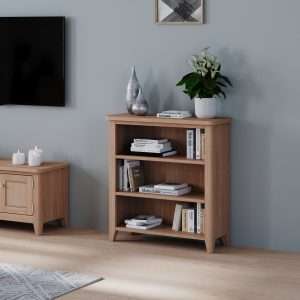
Colour can help, but it should not dominate. A run of similar spine colours can look smart, while a fully rainbow arrangement can feel lively but busy. In a calm living room or bedroom, a more restrained mix often sits better with oak furniture. In a study, practical order may matter more than perfect colour matching. The right choice depends on what the room is for and how much visual noise it already contains.
What to keep off the bottom shelves
Fragile objects, tall unstable pieces and anything likely to leak or stain are poor choices for the lowest shelves. Very small collectibles are easy to miss and easy to disturb. Oversized ornaments that overhang the shelf edge can catch on clothing or furniture. Pots without saucers can mark wood, and open containers of pens or pencils can look messy very quickly.
It is also wise to avoid mixing too many purposes on one shelf. A basket of paperwork, a stack of books, a plant and a loose toy may all be useful, but together they make the shelf look like a dumping ground. If each item has a reason and a defined spot, the arrangement will feel more considered. That is especially true in compact rooms, where storage is often asked to do several jobs at once.
oak display bookcases can carry a wide mix of objects, but the lower shelves still benefit from restraint. Heavy books, a basket with a clear job and one larger display piece are often enough. When the bottom feels steady and uncluttered, the rest of the bookcase is easier to arrange and the room looks more orderly without feeling staged.
A good final check is to stand back and look at the whole unit rather than each shelf in isolation. The lower shelves should feel like the base of the arrangement: practical, calm and strong enough to support whatever sits above. If the bottom shelf looks balanced, the bookcase is more likely to feel useful in the room instead of simply filling a corner.